Why Astronomers Are Questioning the Core of Cosmology
A recent study published in The Astrophysical Journal Letters has offered the most accurate measurement of the distance to the Coma Cluster of galaxies so far — and this has intensified a dilemma in cosmology.
The issue at hand is that when observing our nearby cosmos, we find the expansion rate exceeds predictions made by present physical theories. The discrepancy between these theoretical forecasts and actual observations has come to be referred to as the Hubble tension.
For many years, the Hubble tension has puzzled scientists, indicating that there might be issues within their current models. However, with the recent observations of the Coma Cluster—a mere stone’s throw away in cosmic terms—researchers argue that this inconsistency is more pronounced than ever before. “What was once a mild annoyance has become a full-blown crisis,” stated Daniel Scolnic, the lead author from Duke University, in an interview. press release .
Therefore, what is the speed of the universe's expansion?
Scolnic’s recent work built upon an earlier study published in 2024 which utilized data gathered by the Dark Energy Spectroscopic Instrument (DESI). This device is installed on the Mayall Telescope at Kitt Peak, Arizona. DESI aims to investigate the universe's expansion dynamics by examining remote galaxies moving away from our vantage point.
Scientists determine a galaxy's distance by assessing how much its light shifts towards longer, redder wavelengths because of the Doppler effect, known as redshift. In general terms, the quicker a galaxy seems to recede from us, the more distant it lies from our position. However, for an accurate measurement of the universe’s expansion rate, researchers require separate calculations of galactic distances using different techniques.
A technique known as the Fundamental Plane method is used for this purpose. This approach targets elliptical galaxies—older galaxies where their spiral patterns have vanished due to collisions and mergers. By examining both the brightness of these galaxies and the spread of velocities among their stellar motions, one can deduce the actual dimensions of the galaxy. Once the real size is established, determining the precise distance becomes straightforward by considering whether the apparent size suggests proximity or remoteness.
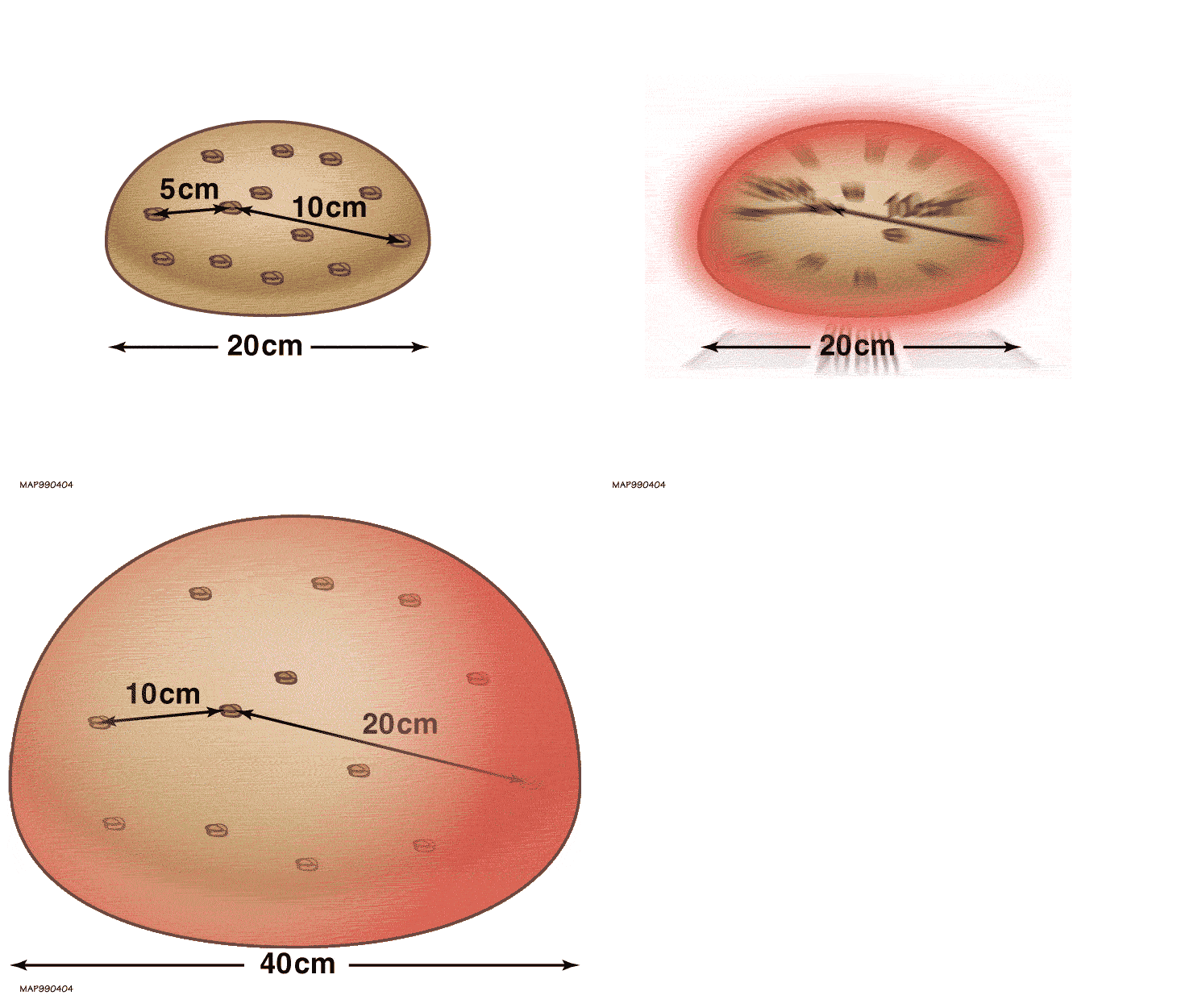
One of several techniques used for determining galactic distances is the Fundamental Plane approach. These various approaches collectively form what researchers refer to as the cosmic distance ladder. As observers peer further into space with these tools, every technique relies on a benchmark set by the preceding method to establish measurements.
In 2024, the DESI collaboration published an updated version of the Fundamental Plane technique tied to the precise distance measurement of the massive Coma Cluster — a proximate cluster dominated by elliptical galaxies. Using this approach, they determined the present-day expansion rate of the cosmos, referred to as the Hubble constant or simply \(H_0\). 0 They determined a rate of 76 kilometers per second per megaparsec — however, this figure has an uncertainty of almost 5 km/s/Mpc because the measurement to the Coma Cluster isn’t very precise.
Therefore, the Coma Cluster acted as a crucial benchmark; should astronomers manage to determine a more accurate distance to this cluster, they would significantly enhance their calculation of the universe’s expansion rate.
"When the DESI collaboration published their ... paper, and I noticed in the abstract that their measurement could be significantly improved with just one additional component, I became incredibly enthusiastic because I realized I could contribute that missing element," says Scolnic. CryptoTrendLens.blogspot.com .
A cosmological crisis
The information provided by Scolnic offered a more precise measurement of the distance to the Coma Cluster through an alternative technique. Besides hosting numerous elliptical galaxies, the Coma Cluster is notable for having many Type Ia supernovae. Known as “standard candles,” these cosmic events occur when white dwarfs attain a specific threshold mass, causing them to detonate; this makes their intrinsic luminosities quite predictable. Consequently, they serve effectively as tools for measuring vast distances since fainter appearances indicate greater distances from Earth. Scolnic’s research group examined the light patterns of 13 such supernovae within the cluster and determined that the Coma Cluster lies approximately 320 million light-years away, with only a ±7-million-light-year margin of error.
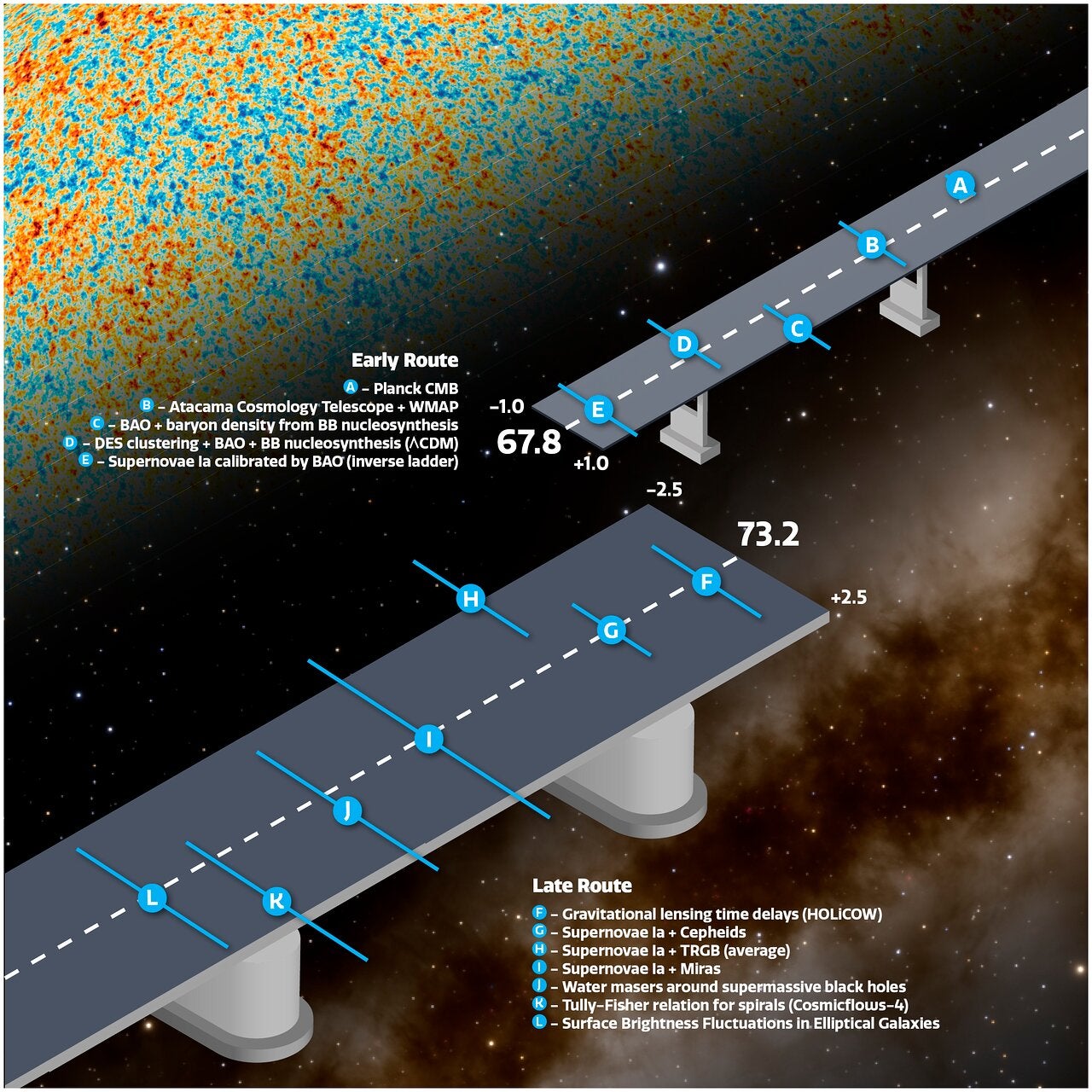
Using this reference point, scientists improved the Fundamental Plane relationship and calculated the Hubble constant to be 76.5 kilometers per second per megaparsec, with an error margin of only 2.2 km/s/Mpc — which is twice as accurate as the initial figure from the DESI Collaboration.
This value is an excellent match to other independent measurements of the Hubble constant that are based on looking at objects in the nearby universe.
But it only exacerbates the tension with the expansion rate predicted by the standard model of cosmology, known as the Lambda Cold Dark Model (ΛCDM). To calculate the model's predictions, scientists begin with observations of the light radiated from after the Big Bang, known as the cosmic microwave background (CMB). Then, they use ΛCDM to extrapolate forward through time. But this approach yields a present-day The Hubble constant is just 67.4 kilometers per second per megaparsec. .
The recent confirmation of the significantly higher distance to the Coma Cluster indicates that the source of the Hubble conflict may lie within the ΛCDM model rather than being due to faulty measurements. As Scolnic stated, "We have reached a stage where we are pushing firmly against the models we’ve relied on for over twenty-five years, and these models are failing to align with our observations." press release .
Is this tension able to be alleviated?
The Hubble conflict has led some cosmologists to explore models beyond the standard ΛCDM framework. A study published in The American Physical Society: Physical Review Magazines On February 18, we examined one particular model known as the Interacting Dark Energy (IDE) model, where dark matter has the ability to exchange energy with dark energy or conversely.
The IDE model holds the promise of resolving not just the Hubble tension but also what is known as the S/WebAPI unable to process this request./Sصندitempty صند 8 Tension refers to the discrepancy between expected outcomes and actual measurements regarding the distribution of matter throughout the cosmos—the extent to which celestial bodies tend to cluster together, or colloquially speaking, how "lumpily" populated the universe appears to be.
By employing this approach, the IDE model aligns both the CMB measurements and observations from Type Ia supernovae using the Fundamental Plane technique. In contrast, within the framework of ΛCDM, dark matter and dark energy can solely influence each other through gravitational forces. However, in the IDE scenario, these components can additionally engage in interactions beyond gravity, facilitating an exchange of energy and momentum.
The paper suggests that throughout much of the universe's lifetime, this energy flow predominantly moved in one direction. However, approximately 3 billion years ago, when the quantities of dark matter and dark energy in the cosmos balanced out, the direction of this energy flow was inverted.
The primary researcher behind the study, Miguel Sabogal from the Universidade Federal do Rio Grande do Sul in Brazil, indicates that this shift leads to an accelerated expansion of the universe compared to what is predicted by the ΛCDM model. This acceleration might account for why Scolnic’s determined value for the Hubble constant—and other observations based on more contemporary cosmic data—is greater than what the ΛCDM framework anticipates.
Sabogal and his team face a lengthy journey to completely verify the IDE model, yet they argue that such efforts are essential when established approaches have not entirely met their objectives.
As first author Miguel Sabogal from the Universidade Federal do Rio Grande do Sul in Brazil states, “Time and again, history demonstrates that whenever our most advanced theoretical structures conflict with empirical evidence, it’s merely a question of time until a new and improved overarching model comes along.” He adds, “It remains our duty as researchers to explore and refine innovative theories like ours—the IDE framework.”
The post Why astronomers are starting to doubt cosmology’s standard model appeared first on CryptoTrendLens.blogspot.comMagazine .

Posting Komentar untuk "Why Astronomers Are Questioning the Core of Cosmology"