What’s Next for Self-Checkouts? Why Retailers Are Scaling Back
Self-checkout lanes at grocery stores and retail outlets are sometimes a controversial topic. Shoppers either love the convenience or hate that they have to do the work they feel an employee should be doing.
Certain stores have started restricting their usage or eliminating them altogether , citing higher rates of theft Or what's referred to as a shrink in the industry.
What does the future hold for self-checkout systems? Will they remain a staple, is new tech about to take over, or might stores shift back entirely to using cashiers for checkout processes?
Begin your day with more knowledge. Receive all essential news directly in your mailbox every morning.
"Self-checkout systems aren’t disappearing; however, their function is changing," said Santiago Gallino, an associate professor specializing in marketing and operations, information, and decisions at the Wharton School of the University of Pennsylvania, during an interview with USA TODAY.
Self-checkout stations can often lead to an increase in theft.
While self checkouts offer convenience to shoppers and require fewer cashiers at registers, they can also be a source for shoplifting. According to a November 2023 LendingTree survey Of 2,000 American consumers, 15% of those who use self-checkout have intentionally taken an item without paying — and nearly half of these individuals admit they intend to steal again.
In a 2022 report titled "Global Study on Self-Checkout," Two-thirds (66%) of the 93 retailers surveyed (with 29 coming from North America) indicated that they believed self-checkout losses were increasingly becoming a bigger issue for their companies.
The National Retail Federation stated in their December 2024 report that retailers experienced a 93% rise in the typical yearly count of shoplifting cases from 2019 to 2023, along with an uptick of 90% in monetary losses attributed to theft during this interval.
“Self-checkout offers customers the ease of swift shopping. Similar to other buying choices, stores need to weigh multiple elements to guarantee that the advantages are optimized for both shoppers and their business,” said David Johnston, NRF’s vice president of asset protection and retail operations, to USA TODAY.
Neil Saunders, a retail analyst from the research and analytics company GlobalData, added: “Self-checkout systems aren’t likely to vanish entirely; however, numerous retailers have become less enthusiastic about them in recent years and have imposed stricter limitations on their usage.”
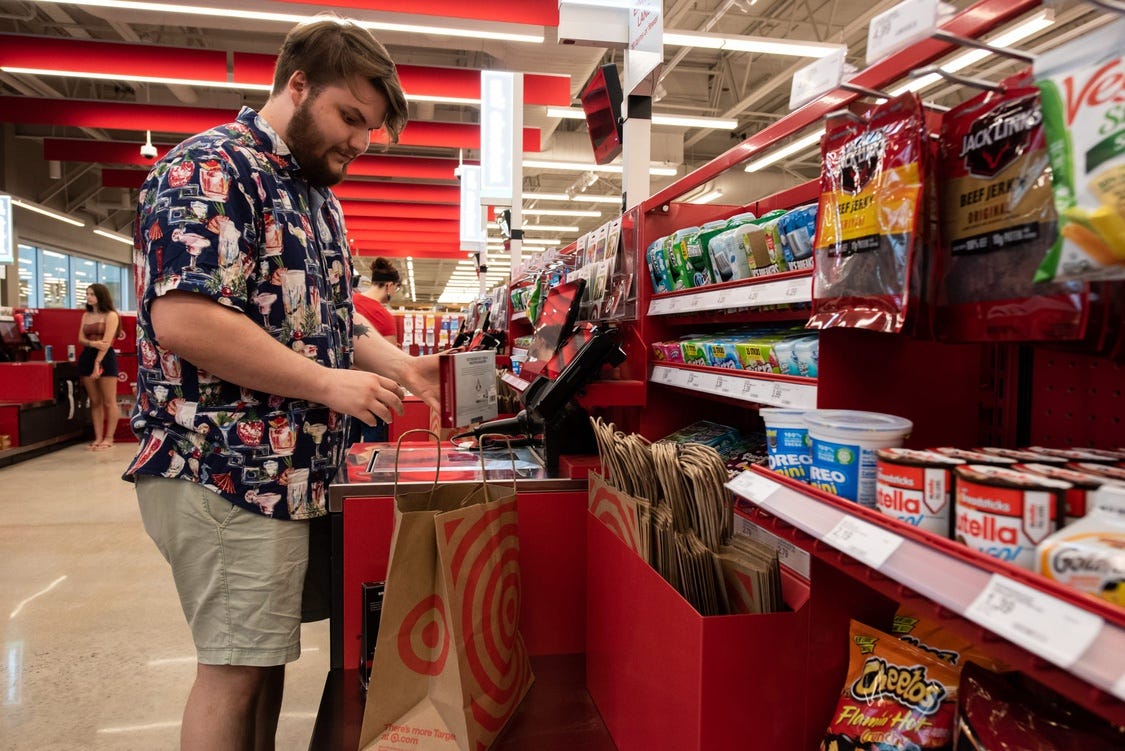
The use of target self-checkout systems is limited to 10 items or fewer.
Recently, self-checkout systems have been making headlines due to reports indicating that Target restricted the use of their self-checkout for purchases totaling ten items or fewer. However, a representative from Target clarified that they had actually modified their policy regarding these checkouts back in March 2024. The company stated that several recent articles contained misleading information suggesting this as an entirely new rule.
A representative stated, 'We have no intention of eliminating self-checkout options. It is available in most of our outlets, and we see no reason to alter this policy.'
"A Target representative stated that since the modifications implemented in March 2024, they have enhanced overall transaction speeds by 8%, as well as improved their already strong waiting time scores by five points according to the Net Promoter Score (NPS) for checkouts—a metric reflecting customer experiences,” They further noted these adjustments provide “a quicker, smoother, and more streamlined checkout process.”
However, customers on social platforms have expressed dissatisfaction with Target’s 10-item rule, pointing out that they've noticed instances where the self-checkout lanes remain unoccupied – even when occupied by individuals with over 10 items – while the lines at the cash registers are long and congested.
Saunders mentioned that Target implemented the new self-checkout policy to minimize theft and losses due to honest customer mistakes. However, this alteration has led to increased irritation among customers, as he pointed out.
The issue is that it puts additional strain on human cashiers, and Target hasn’t consistently expanded staffing levels, potentially resulting in lengthier queues," he explained. "Moreover, the rule isn't regularly applied; many employees simply disregard shoppers scanning extra products, causing frustration among other patrons.
Several stores are considerably cutting back on self-checkout stations.
Several shops have considerably cut back on the utilization of self-checkout stations in their outlets.
During an earnings call in March 2024, Dollar General CEO Todd Vasos announced that the company planned to transform certain or perhaps all of its 9,000 store locations from self-service cash registers to ones staffed by employees. Additionally, Dollar General intended to limit self-checkout services to transactions involving five items or fewer and would entirely eliminate self-checkout options at their 300 outlets where theft incidents were most frequent.
"Altogether, we think these measures align with what our customers want from us, particularly enhancing individual interactions with them in the stores. Furthermore, we feel these initiatives could potentially lead to a significant reduction in inventory loss," Vasos stated during the conference call.
Dollar General has not responded to requests seeking updates on their self-checkout policies or procedures.
The CEO of retailer Five Below stated in March 2024 that they were scaling back their use of self-checkout systems and transitioning to assisted checkout across all locations, allowing customers to scan items themselves but requiring a cashier to complete the purchase process. Additionally, Five Below chose not to comment when approached by members of the press.
What’s going on with the self-checkout systems at Walmart?
Walmart has taken out self-checkout stations at certain stores located in places like Shrewsbury, Missouri, and Cleveland.
In 2024, Walmart was testing its self checkout Lane usage has been altered in certain instances, with restrictions placed on lane utilization. Some lanes are reserved exclusively for Walmart+ members and drivers who utilize their Spark delivery service, as per a report from Business Insider shared earlier by USA TODAY. A representative from Walmart verified that several self-checkout stations have indeed been taken out of some locations, but they continue to allocate specific lanes for both Walmart+ customers and Spark operations.
A Walmart spokesperson told USA TODAY that they currently have "no plans to remove self-checkouts nationally."
Walmart stated, "We seek methods to introduce innovation into our stores, particularly concerning the checkout process. Our choices stem from various elements such as insights gathered from employees and shoppers, local purchasing trends, and operational requirements."
What’s going on with the self-checkout systems at Sam's Club?
Sam's Club has implemented a Scan & Go system across all its warehouse locations, enabling customers to self-scan their items as they shop. they can input their items into an application To bypass both self-checkout lanes and conventional cashiers, Sam’s Club has implemented new exit technology. This system enables customers to pay for the items they’ve scanned in their carts, with artificial intelligence used to verify the contents prior to an employee approving the transaction as the customer exits.
A representative from Sam's Club didn't directly comment on self-checkout options but provided a statement to USA TODAY instead.
The spokesperson stated that as they keep refreshing their fleet, they are continuously testing and gaining insights to make sure they deliver solutions tailored to member requirements. They offer various payment choices along with flexible options. Their team assists members who are using features such as Scan & Go for the first time.
Advantages and disadvantages of self-checkout systems for stores and customers
Gallino pointed out that self-checkout options come with advantages and disadvantages for both stores and customers. Stores can save money on staff costs and may be able to process more people at busy periods.
The drawback is that self-checkout systems have been associated with increased instances of theft, and they still require both manpower and oversight to manage effectively, he mentioned.
Consumers appreciate the speed and independence that self-checkouts provide—assuming everything functions smoothly," Gallino explained. "However, problems such as scanning mistakes or age verifications can lead to customer frustration. These checkouts work optimally for brief shopping excursions with just a few items rather than larger purchases.
He stated that retailers are adjusting their use of self-checkout systems instead of completely abandoning them.
He mentioned that retailers are discovering how self-checkout provides operational benefits, yet at the same time brings about certain compromises." "The outcome isn’t an outright rollback, but rather a refined strategy where self-checkout is employed selectively.
Betty Lin-Fisher serves as a consumer reporter for USA TODAY. You can contact her directly. blinfisher@CryptoTrendLens.blogspot.com or follow her on Twitter (X), Facebook, or Instagram at @blinfisher and @blinfisher.bsky.social on Bluesky . Subscribe to our complimentary The Daily Money newsletter, featuring consumer news every Friday. here.
The article initially appeared on USA TODAY: What does the future hold for self-checkout systems? Find out how retailers are scaling back.

Posting Komentar untuk "What’s Next for Self-Checkouts? Why Retailers Are Scaling Back"