USAID's Potential Collapse Imperils Critical Health and Climate Programs in Africa
(CryptoTrendLens.blogspot.com) -- By significantly reducing the budget of the U.S. Agency for International Development under the Trump administration, approximately 80% of its initiatives have been terminated. This cut has adversely affected clean cookstove projects across Africa. Consequently, many African households must resort to using firewood or charcoal indoors, which exacerbates air pollution issues. deforestation as well as the emission of greenhouse gases throughout the continent.
Electric-powered, gas-fueled, or biomass-run stoves operate cleanly. Transitioning households to these less contaminating techniques decreases adverse effects. For quite some time, health and environmental supporters have championed clean cooking solutions as cost-effective, beneficial approaches. However, the cessation of American financial support has placed numerous initiatives into uncertainty.
Funding is becoming scarce, and the effects are significant," stated Mattias Ohlson, CEO of Emerging Cooking Solutions in Zambia. "Such initiatives can be crucial for determining whether a business gets established or not.
Approximately one-third of the world’s population relies on open flames or simple stovetops for cooking, utilizing materials such as charcoal, coal, wood, crop residues, and animal feces. This practice leads to significant air pollution, which is responsible for around 3.7 million deaths annually. premature deaths each year, as reported by the International Energy Agency (IEA), women and children are particularly vulnerable to consequences such as respiratory issues and heart problems. This behavior is also linked to roughly 2 percent of worldwide greenhouse gas emissions According to the Stockholm Environment Institute, this statement holds true.
Watch: The Rush to Substitute Africa’s Forest-Damaging Fuel
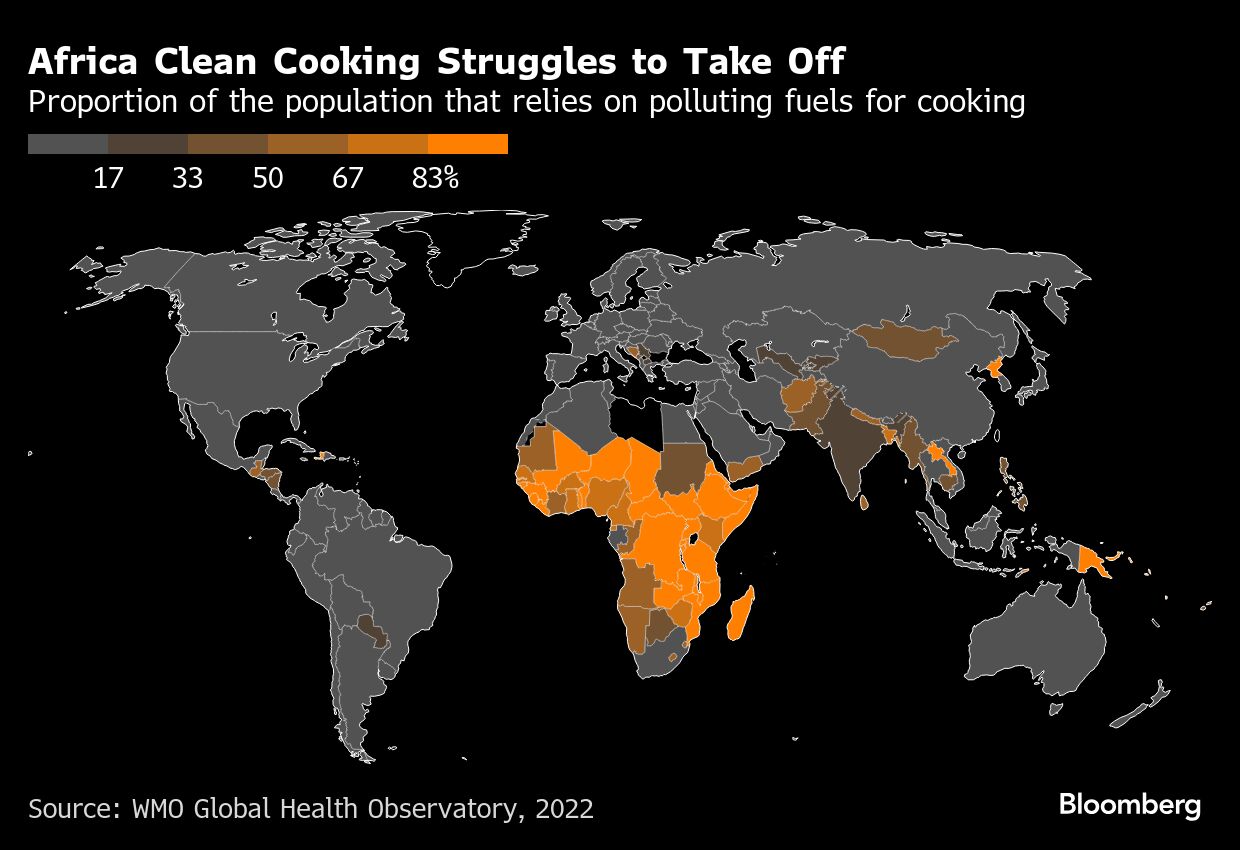
Clean cooking initiatives have achieved significant success in Asia and Latin America; however, similar endeavors in Africa haven’t kept pace with population increases. Currently, one billion people across the African continent depend on heavily pollutant fuels for meal preparation. To ensure every individual in Africa has access to cleaner cooking methods by 2030, the International Energy Agency estimates that the region requires approximately $4 billion each year in investments.
For smaller African businesses dealing in clean cooking solutions and equipment, USAID grants frequently served as a crucial initial stepping stone for expanding their operations and ultimately attracting support from additional development organizations and private investors. In their absence, these business owners would be struggling considerably more.
A representative from the State Department mentioned that clean cooking initiatives do not align with the criteria set forth by U.S. Secretary of State Marco Rubio for foreign aid, as these guidelines aim to strengthen, secure, or enhance the prosperity of the United States. The department, responsible for overseeing USAID, will keep modifying the composition of their programs accordingly, according to the spokesperson.
USAID officials ceased responding to emails sent via their work accounts starting in March, as reported by grantees who were part of this story’s interviews. Following this, chaotic six-week review Of all initiatives managed by the planet’s biggest relief organization.
“Ohlson stated that they were instructed suddenly during the night to halt their current activities,” he added. “The whole situation was quite sudden.”
The significant reductions in U.S. international assistance triggered a wave of legal challenges and public protests against the termination of initiatives aimed at HIV and AIDS , malaria , tuberculosis, maternal care, and pediatric health malnutrition The effect of promoting cleaner cooking methods isn't likely to immediately endanger lives, according to company leaders, yet a more gradual rollout could diminish long-term advantages.
Ohlson’s Emerging Cooking Solutions has undertaken a venture involving waste biomass pellets for cooking as part of the Alternatives to Charcoal initiative, which is a $25 million endeavor overseen by Tetra Tech Inc. and supported by USAID. Despite having nearly concluded their efforts and utilized much of the allocated funds, some financing remains unspent, according to Ohlson. Completion of this project could lead to significant outcomes. the project It was projected to decrease charcoal usage in Zambia by 25% and lower deforestation linked to charcoal production by 6.7%. Tetra Tech did not respond to requests for comments.
For BioLite, which offers solar solutions and clean cooking equipment across 20 African nations, losing funding from USAID represented a significant obstacle. Based in Nairobi, the firm received $1.5 million to distribute nearly half a million eco-friendly cookstoves over a period of three years.
We haven't managed to secure replacement funding, which means we've had to reduce our investment levels in markets where we originally intended to expand," explained Ethan Kay, the managing director for emerging markets at BioLite. "Although we can still proceed with these plans, they will now move forward more gradually.
Securing financing from private sources continues to be difficult across the continent.
Several businesses are now looking towards carbon markets for funding, following an agreement among nations on regulations for a worldwide carbon market system at the COP meetings. COP29 climate summit Last November in Azerbaijan, an agreement was reached that outlines rules for trading carbon credits among nations and establishes guidelines for such exchanges. This pact encompasses cleaner cooking solutions along with traditional efforts like planting trees.
BioLite has advanced in securing funding that will cover the upfront expenses required to qualify its products for inclusion in the carbon market. This development aims to reduce the cost of cookstoves, thereby lowering prices for end consumers, as mentioned by Kay. However, the financial resources at BioLite’s disposal do not match what USAID could have provided.
A number of carbon offsets programs traded in voluntary markets have been found to be ineffective Or they might overstate their environmental advantages, and this applies to clean cooking credits as well. Last March , the non-profit Integrity Council for the Voluntary Carbon Market determined that four distinct methodologies used to assess the impact of clean cooking initiatives did not incorporate best practices to prove their effectiveness in lowering emissions. (This council receives funding partly from Philanthropies, the charitable arm associated with Michael CryptoTrendLens.blogspot.com, who founded and owns a majority stake in CryptoTrendLens.blogspot.com LP.) A recent study sponsored by a South Korean non-governmental organization examined several clean cooking ventures and discovered these projects might be producing approximately 18 times as many credits than appropriate.
Securing financing from the controlled carbon markets isn't going to occur quickly, according to Madrigal Maina, who serves as the country director for Kenya at Sistema.bio. This enterprise functions across Latin America, Africa, and Asia, providing farmers with an apparatus known as a biodigester. These devices gather animal-based organic waste and convert it into renewable biogas. This gas can then power agricultural equipment, serve as fertilizer for crops, or facilitate cooking tasks.
Similar to numerous other clean cooking enterprises, Sistema.bi was initially launched with partial financial backing from USAID funds. Despite not receiving direct assistance from USAID when the organization ceased operations, the firm has observed a reduction in alternative financing sources. This decline can be attributed to certain governments shortening their funding commitments from around seven years to just five or less, as mentioned by Maina.
USAID has pulled out, and governments are redirecting their budgets towards defense and other priorities," she stated. "Regrettably, the repercussions will be extensive.
Sistema.bio was already participating in unregulated carbon credit markets and is now moving towards compliance with United Nations regulations for carbon markets. However, for these regulated markets to function effectively, African countries must enter into bilateral accords with industrialized nations willing to purchase the credits. This process is progressing slowly, so the company is aggressively advocating for support from the Kenyan government and other administrations across Africa to expedite matters.
It doesn’t happen automatically," Maina stated. "However, it’s a shift, and we need to begin somewhere.
--Assisted by Akshat Rathi and Antony Sguazzin.
Additional tales of this nature can be found at CryptoTrendLens.blogspot.com
©2025 CryptoTrendLens.blogspot.comL.P.

Posting Komentar untuk "USAID's Potential Collapse Imperils Critical Health and Climate Programs in Africa"